
pmle
PMLE Exam Weights 2026 Shift Explained | WiseOwlLearns
Discover how the Google Cloud PMLE exam weights shifted in June 2026. Less focus on MLOps pipelines, more focus on scaling foundation models.
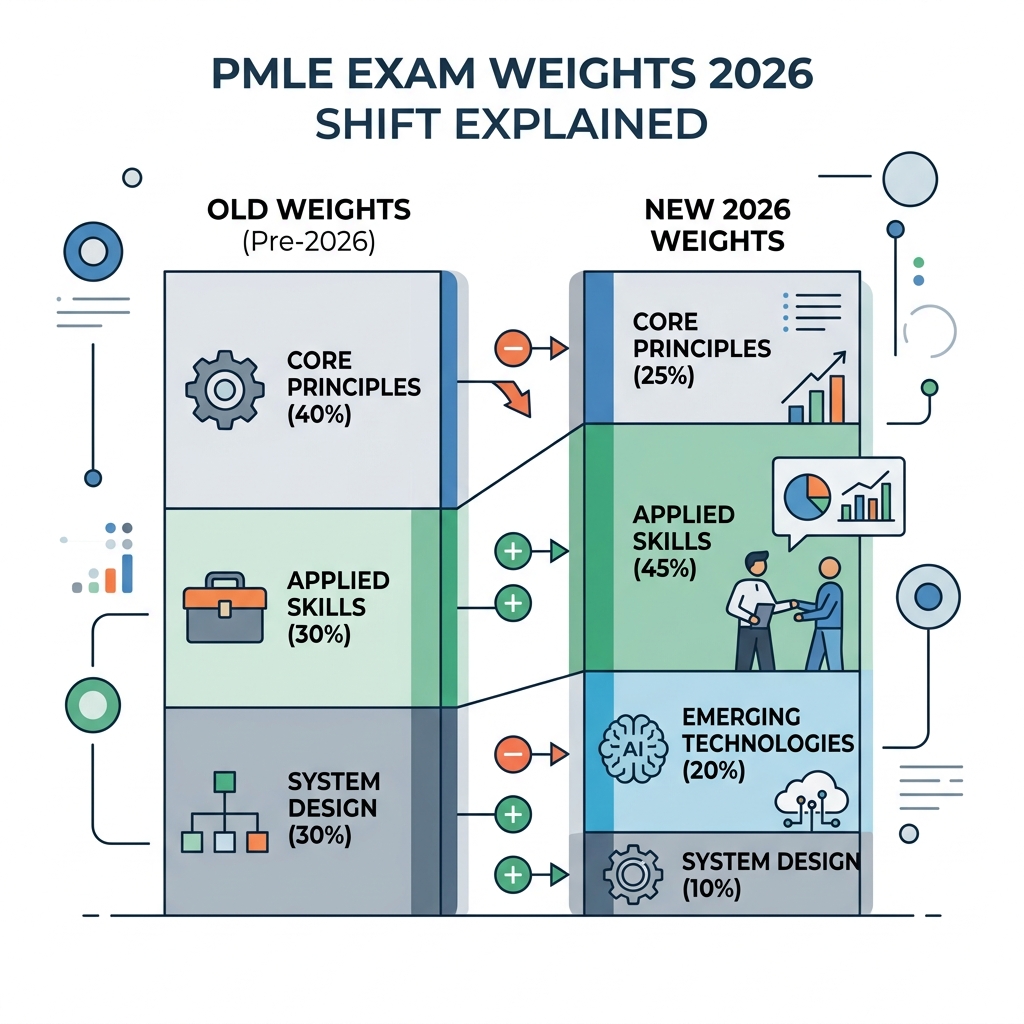
When Google Cloud updated the Professional Machine Learning Engineer (PMLE) exam on June 1, 2026, they didn’t just change the names of the services. They fundamentally rebalanced the exam to reflect the reality of modern AI workloads.
If you are following a study guide written in 2025, you are spending too much time on deprecated orchestration frameworks and not enough time on what actually matters today: scaling foundation models and generative AI.
Here is a deep dive into the PMLE exam weight shifts and how they should change your study strategy.
The Complete Objective Weight Shift
Google has rebalanced the PMLE exam across its six objectives. The most significant shifts emphasize the deployment and monitoring of models over low-level pipeline orchestration.
| Exam Objective | Pre-2026 Weight | June 2026 Weight | The Shift |
|---|---|---|---|
| 1. ML Problem Framing | ~13% | 18% | 📈 +5% |
| 2. Architecting ML Solutions | ~16% | 18% | 📈 +2% |
| 3. Designing Data Systems | ~18% | 19% | 📈 +1% |
| 4. Developing ML Models | ~20% | 21% | 📈 +1% |
| 5. Automating ML Pipelines | ~22% | 12% | 📉 -10% |
| 6. Monitoring ML Solutions | ~11% | 12% | 📈 +1% |
Note: Pre-2026 weights are approximate based on historical exam analysis, while the June 2026 weights are official.
The Biggest Loser: Objective 5 (Pipeline Orchestration)
The most dramatic change is the 10% drop in Objective 5: Automating and orchestrating ML pipelines.
Why the decrease? Google has largely deprecated TFX and moved away from requiring candidates to know the minutiae of low-level MLOps orchestration. The industry has shifted towards managed solutions and higher-level abstractions.
What you should study instead: Instead of memorizing TFX components, focus on understanding when to use Managed Service for Apache Airflow (formerly Cloud Composer) versus event-driven architectures using Eventarc and Cloud Run.
The Biggest Winner: Objective 1 & 2 (Architecture and Framing)
Combined, ML Problem Framing and Architecting ML Solutions now make up a whopping 36% of the exam.
Why the increase? The proliferation of Generative AI has made architectural judgment more critical than ever. It’s no longer just about knowing how to train a model, but whether you should train a model, fine-tune a foundation model, or simply use an API.
What you should study:
- Judgment Under Constraint: Expect scenario questions that ask you to balance cost, latency, and scalability.
- API vs. Custom: Know exactly when to use the Gemini Enterprise Agent Platform APIs versus deploying a custom container to GKE or Cloud Run.
Adjusting Your Study Plan
To pass the new 2026 PMLE exam, you need to adjust your study priorities:
- Stop over-indexing on TFX and Kubeflow. Understand the concepts of orchestration, but don’t get bogged down in the low-level code.
- Master the Gemini Enterprise Agent Platform. Know the difference between zero-shot, few-shot, and parameter-efficient fine-tuning (PEFT), and when to use each.
- Focus on Latency and Cost. Every architectural decision you make on the exam will be judged against latency requirements and budget constraints.
At WiseOwlLearns, we rebuilt our entire question bank to reflect these new weightings. Our Option Analyzer™ specifically trains you on “Judgment Under Constraint,” breaking down why one architectural choice is better than another based on the specific constraints in the question stem.